
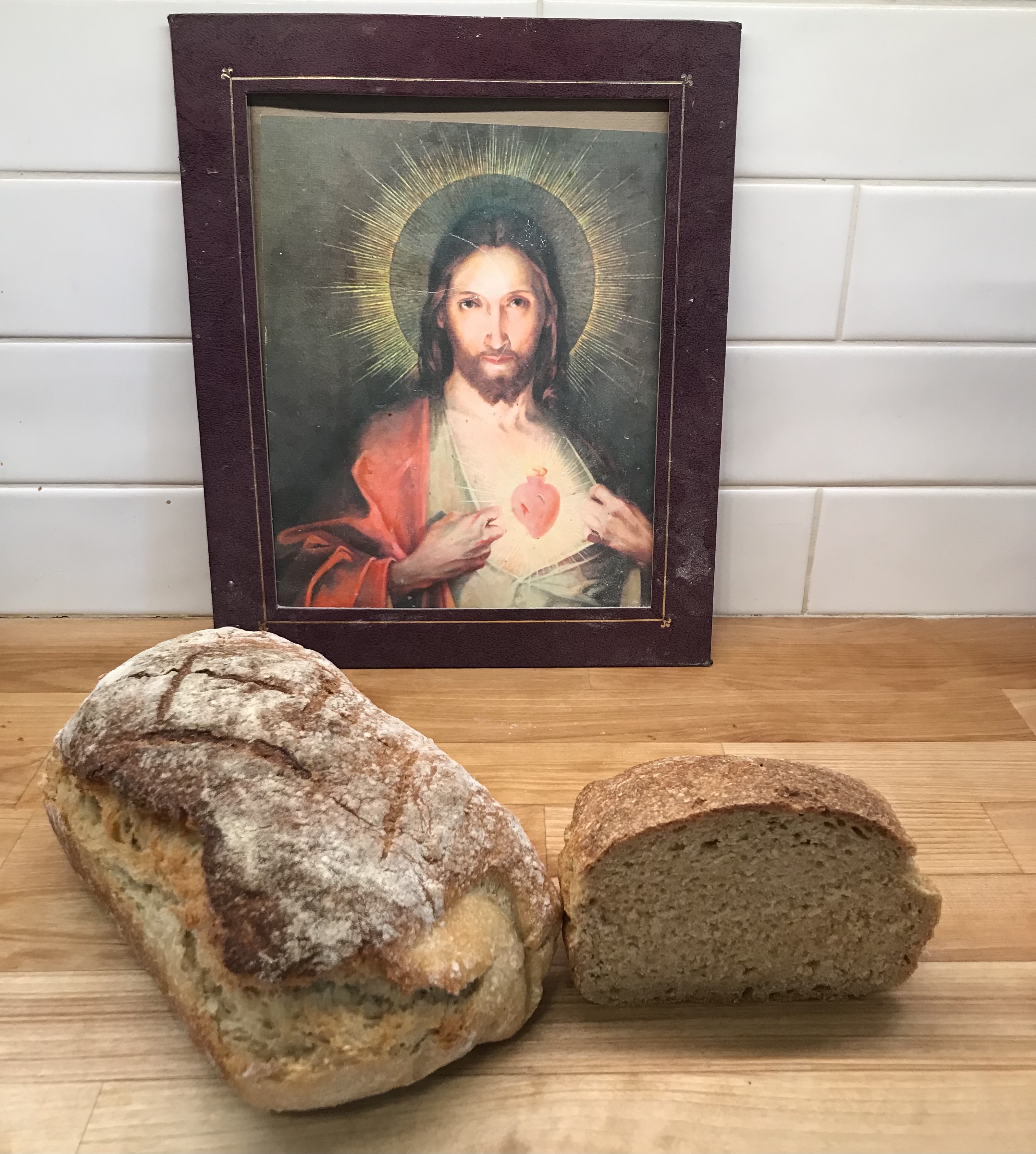
Today I am sharing an article from our 2019 CSA Newsletter, which was in print, because it shares a lot of interesting things about sourdough bread!
This month I’d like to share what I’ve learned about
sourdough bread, as well as the ingredients and process
I use to make it!
The bread I sell is a whole wheat
sourdough loaf. When I bake bread, I freshly grind
Wheat Montana’s chemical-free, non-GMO whole
wheat kernels to have the freshest whole wheat flour
possible (whole wheat flour loses 60% of its nutritional
value within 15 minutes after it is ground, and goes
rancid rather quickly). I also use organic
unbleached all-purpose flour, which allows the bread to
rise better than a strictly whole wheat loaf. The other
ingredients are water, French sea salt, and starter, which is
made of the all-purpose flour and water.
The process I use is fairly time-intensive, but very
rewarding. I prepare the leaven the night before from
my starter, then in the morning freshly grind the grain in
an electric grain mill. I mix the ingredients, next turn the
dough every half hour or so for a few hours, then every
15 minutes until the dough is ready for the initial
shaping. After a 30 minute rest, I do the final shaping, at
which point the bread rests and rises for 3 to 4 hours.
Then it’s time to bake and the bread is ready in the late
afternoon or evening.
My first motivation for making this bread was health.
This is the healthiest bread there is! As evidenced by
many cultures, grains are best digested by humans when
they have been pre-digested in one way or another—be
it sprouting, soaking, or fermenting. If you are interested
in learning more about this, check out Nourishing
Traditions by Sally Fallon, the Weston A. Price
Foundation, or Beautiful Babies by Kristen Michaelis.
Basically, all grains are seeds. They want to grow more
grain, so they have an anti-nutrient coating that helps
them pass through the gut of the animal that eats them
while remaining a viable seed. While they are full of
nutrients, this anti-nutrient coating counterbalances the
nutritional value even when cooked or ground into
flour.
However, people have passed down the
knowledge of pre-digesting this grain in order to break
down those anti-nutrients in every world culture that
eats grain. Sourdough bread relies on fermentation of
the starter combined with soaking of the flours while
the dough rises for hours.
Unfortunately, modern food relies more on convenience
than on any traditions, no matter how that affects things
such as health, depth of flavor, and being attentive to
the nature of things. The typical grocery store bread you
can squish into a ball has tons of preservatives, does not
fill you with its serving size, and certainly is not made
slowly enough to allow for a proper soaking or
fermenting of the grain.
As this bread has been around
for a few generations now, it seems quite plausible, as
others have claimed, that gluten sensitivity and celiac
disease are on the rise because our bodies cannot
tolerate this modern thing we call a loaf of bread! It is
truly fascinating that there are people (even CSA
members!) who are gluten sensitive but who can eat and
enjoy properly prepared sourdough bread! [I am not
referring to those who have Celiac disease, but just to
those who are gluten-sensitive].
But there is more to eating sourdough than the health of
the matter! Isn’t it amazing that Jesus Christ Himself
chose bread, simple bread, to be taken up in the
Eucharist? That is truly something to ponder!
Bread is a beautiful food. Unlike making a soup,
cooking a meat, or preparing a salad or even a sandwich,
once you combine the ingredients and bake it, bread dough
becomes something new. In that soup or meat or salad
or sandwich, you can still see the ingredients that went
into them. With bread, the flour, water, leaven, and salt
have all been transformed—and they make something
truly delicious!
Sourdough bread is itself particularly beautiful. Rather
than relying on yeast that is mass-produced, true
sourdough uses fermented starter to capture yeasts in
the air. The starter, and then the bread dough which
includes the starter, is alive! And even after it is baked,
sourdough bread can continue to develop its sourness as
a result of that fermentation process!
Interestingly enough, the blue mold that grows on
sourdough bread is the same mold that is used to
culture blue cheese, unlike the myriad inedible molds
that grow on store-bought bread. This seems to me to
be correlated to how sourdough feeds the healthy
bacteria in the human gut, as opposed to the not-so-
healthy gut bacteria that store-bought bread feeds.
Originally our family started eating only sourdough
bread because we learned that it is the most healthy,
nourishing, traditional bread there is. This is true, and
was a good motivation for us to pursue sourdough.
However, the more we reflect on the tradition, beauty,
and symbolism of making and eating this type of bread,
the more we enjoy this beautiful food! I hope you will
give it a try and enjoy it too!
Join our Mailchimp List to get all of our emails and stories!
More From the Blog
Cranberry Hibiscus Sorbet
Make Kelly’s Cranberry Hibiscus Tea. Make a honey simple syrup by mixing 1 cup honey and 1 cup water in a jar with a lid and shaking until combined. Add simple syrup to tea to taste. Refrigerate until cold. Pour into an ice cream maker and freeze as directed. If you don’t have an ice…

Lemon-Basil Shortbread
This recipe made enough dough for an 11”x17” jelly roll pan! So you can feel free to half or even quarter this recipe and it will still make a decent amount of shortbread! Also, you can lessen or increase the amount of Lemon-Basil, as the amount of leaves you use will make the flavor more or less…

Stephen’s Arugula-Dandelion Dip
Pulse the following in a food processor until finely chopped: 4 oz. Arugula, washed & picked to remove woody stems 3.5oz Italian Dandelion 1 head Spring Garlic, roots and stem removed 1-2 Tablespoons Apple Cider Vinegar, as needed 1-2 Tablespoons Extra Virgin Olive Oil, as needed Meanwhile, beat until smooth: 16 oz. Philadelphia Cream Cheese…
Leave a Reply