
This past Thursday, I spoke to the MOMCO group my sister Roxanne attends in Union Bridge, Maryland. It was a lovely morning and this was an inspiring group of prayerful women! I thought I’d share the notes I prepared ahead of time for my talk as my blog post this week!
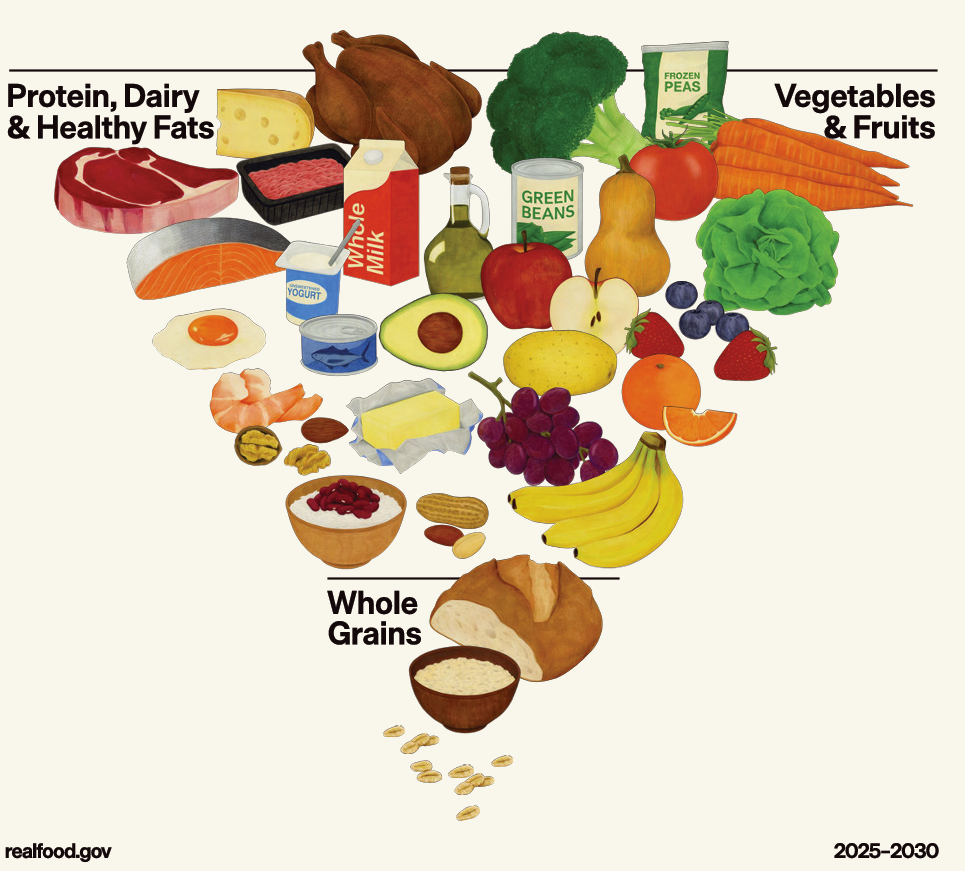
Have you seen the new Food Pyramid yet? It looks very different from the old one!
According to realfood.gov:
- 50% of Americans have prediabetes or diabetes
- 75% of adults report having at least one chronic condition
- 90% of U.S. healthcare spending goes to treating chronic disease–much of which is linked to diet and lifestyle.
Along with updating the food pyramid, the USDA has launched two very important campaigns:
Food as Health and Food as Medicine.
Food as Health deals with all of us in our normal lives and the goal to eat healthier. Food as Medicine has a focus on the medical world, for instance, improving the food that is served to patients in hospitals.
As an organic farmer who was largely motivated to become a farmer in order to provide healthy food to my family, I think these campaigns are a good sign and point us in the right direction as a nation. I would encourage you to check out realfood.gov and learn more.
But I also think the real problem is deeper than what we eat. I think the root of the problem is actually how we eat. Only 29% of families eat together every night. If families aren’t eating together, my guess is that what they are eating is aimed more at convenience than at health.
Only when we restore the number of families eating together every night to the majority will we be able to reduce the numbers of Americans with prediabetes, diabetes, and chronic conditions. Only if we make family dinner the priority will we be able to teach our children both how and what to eat. Only if we make family dinner the priority will be be able to reteach ourselves what and how to eat.
I think it’s helpful as Christian mothers to remember that when Christ tells us that we feed him in the hungry, feeding our hungry children counts!
So how do we want to feed our children, our little Christs?
- At the table in our homes (the table is the altar of our home)
- With manners (that includes without phones and other screens)
- Grace before meals
- Teach them to eat what they are served
- Teach them how to eat and be grateful
- Teach them to like what is good for them
- To have conversation with the meal
- To listen when others are speaking
- To know the importance of having family dinners when they grow up and have their own families
The most important thing in this is the commitment to do it: to eating dinner together every night (of course there are exceptions, but maybe try to keep it to once a month or less? Do what’s reasonable for your family).
But how do we make family dinner the priority? I have some suggestions, and then I thought we could open up for small-group discussion.
- Throw out the processed food. This is hard at first, but the less processed food you have around, the easier it is to make sure you and the kids are getting the good healthy food!
- Limit snack times and set meal times. While we are all busy, you can find a time that works for family dinner. Right now, our family is eating at 7:30 each evening at the earliest. That’s hard for the little girls sometimes, but it’s worth it. This means that we time a snack before soccer practice. We try to limit our snacks to once or twice a day (and keep them whole foods–yogurt, fruit, or smoothie made by blending milk/yogurt and frozen fruit).
- Join a Veggie CSA–this commitment is like signing up for a gym class or a sports team. You’ve paid the money for the team, the class, or the healthy food, and so you’re going to be motivated to get your money’s worth by actually using it.
- As a bonus, most CSAs provide cooking and recipe suggestions by email. Read those emails so you enjoy what you’re eating
- Teach your children to cook with you. This is super important: it gives them the ability to be independent when the time comes and it will make their lives so much easier when they become parents if they have learned from you! My husband loves to cook, and he and his siblings all cooked with their mom. I learned the very basics from my mom, but I’ve had to learn a lot in the past 15 years. I am super grateful that my husband loves to cook, and I am certain that my children know way more about cooking than I did when I was first married! This will make their lives so much easier and more enjoyable when they are out of the house and cooking for themselves!
- Maybe someone in your family will enjoy arranging flowers in a vase as a centerpiece or arranging candles for atmosphere. But it doesn’t have to be instagram worthy–just around a table, with the family facing each other is enough to make it a time set apart from the rest of the day.
- Check out TheFamilyDinnerProject.org for conversation ideas. Or maybe you want to discuss something you heard at church on Sunday, or a scripture passage.
- Serve dessert! But only to the family members who ate their dinner! After a night or two of weeping and gnashing of teeth, most kids will eat their dinner!
- This is also super important: leave phones and screens away from the table. We want to be able to give our husband and our children full attention during dinner time. We want to teach them how to not be rude at the table, and we want to teach them that the people we are with are more important than phones and screens.
- Give children jobs to help clean up after dinner. Depending on their ages and how much time you have, they can do a lot or just a little.
- Joy of Cooking is the best cookbook!
- Choosing different nights of the week when someone is assigned the job of making dinner (learning how up to doing it completely themselves)
- One night a week when you always know what you’re eating (homemade pizza on Wednesdays)
- Making enough for leftovers
- Meal planning (not my strength)
- Vegetables are my inspiration in the growing months–saute most of these in butter and you will love them!
- Simple sometimes, complex other times
- Being able to substitute things in recipes is super helpful!
- Sandwiches or breakfast for dinner (sausage, eggs, and a green)
- Eat around the table. The table in the home is like the altar in the place of worship. I want to share a long quote from a paper I helped my husband Stephen write about the table a few years ago. [It is published in an online journal Humanum. Here is the full paper!]
The altar—and its domestic analogue, the table—is primarily a place of sacrifice: where one “does” or “makes” the “sacred,” a place where one grows in the perfection of love. While one normally thinks of sacrifice as offering something to God alone, the Christian recognizes in the Great Commandment (Mk 12:31) that love of God and love of neighbor are united and that both one’s offering to God and the offering to one’s neighbor are sacrifices. Giving up my best for the other who I do see is identical with giving up my best for the Other who I do not see (cf. 1 Jn 4:20).
Put another way, if we take Matthew’s account of the Last Judgment seriously, we will be judged to the extent that we do not accept the sacrificial character of the world: sacrificing food to the hungry is, in a profound way, offering sacrifice to God (Mt 25:31–46). Moreover, if we consider how creatures are related to other creatures by being for them to the perfection of the whole (cf. Aquinas I.I.47), we must also note that there is a God-given sacrificial character to all things. All things exist for others, bear the capacity to be offered, and offer themselves up, as it were, through their creaturely vulnerability. In a way that prepares for and participates in the altar, the table is the place around which and on which all things are gathered and offered through man to God for the perfection of love.[1]
Just as the life of Christ has public and hidden moments, so too does the life of the Christian. Again, as Matthew’s Last Judgment makes clear, when you feed the hungry, give drink to the thirsty, and clothe the naked, you do so unto Christ. Now the child comes into the world maximally hungry, thirsty, and naked. It is the home of the spouses that shelters him. It is the provision of the parents who clothe her. It is the stewardship of the spouses that feed and quench the child. This intimacy consummates at the table: the place where these moments of love, more hidden than public, reveal the sacrificial character of their lives.
The Christian table presupposes and perfects the table of the unbaptized, just as grace presupposes and perfects nature. By orienting us face to face, the table reveals both man to himself and the nature of the family as a communion of persons.[2] The table is the one place around which the home revolves. It is the center. The table draws every human experience to itself: joys, laughter, sorrows, mourning, correction, discipline, discussion, teaching, silliness, fighting and bickering, sacrifice, and love (cf., Jn 12:32). It is in the nature of the table to gather together, to unite the family for that which is necessary for human flourishing: eating and drinking in a human way. What happens at the table reveals our human fragility and vulnerability, it reveals our creatureliness and our gratitude therein.
In his essay, Leisure the Basis of Culture, Pieper describes the temple as the place of sacrifice and worship that is the grateful, communal celebration of the goodness of being “by praise of the Creator of this very world.”[3] Elsewhere, Pieper says that “if any specific day is to be singled out from the rest and celebrated as a festival, this can only be done as the manifestation of a perpetual though hidden festivity.”[4] The table manifests both the hidden and singular festivity: from simple meals to elaborate feasts. Just as the temple is the place set aside by the polis for celebration, so, in the home, the table is the place set aside for the family’s celebration. Just as feast days are holy time, so, the daily meals are the time separated out. The family’s celebrations participate in the greatest festival meals: Christmas and Easter. At these meals more than any others, the table is itself adorned with festival attire, foods that have taken time to prepare are brought forth from the larder or brine bath, drinks that have aged like homemade mead are poured, and celebrating is required of each member.
To conclude:
As Christian mothers, we are looking to our family meals to provide more than just nourishment and physical health. We want to have a deeply connected family. We want to have good conversation at the dinner table. We want to teach our children to pray, to give thanks to God for all his blessings. Eating dinner as a family every night is of utmost importance for these things.
And to do this, we can’t just ignore the physical needs: we want those meals to nourish both the body and the soul.
Leave a Reply